
Introduction & Objectives
Acoustically, the ocean is interconnected, and sound travels great distances. Therefore, operational noise in shallow waters may displace coastal animals and drive these species offshore (e.g. North Atlantic right whales during migration), while Navy and/or oil and gas operations may displace resident shelf-break and deep- water animals from important habitats. However, shifts in distribution of animals may also occur due to ecological changes, independent of anthropogenic activities. Teasing apart the drivers of these changes can only be done through a clear, well-designed project with a multi-year dataset that enables inference to be drawn before, during and eventually after operations, as well as between sites with low (controls) and high operational activity.
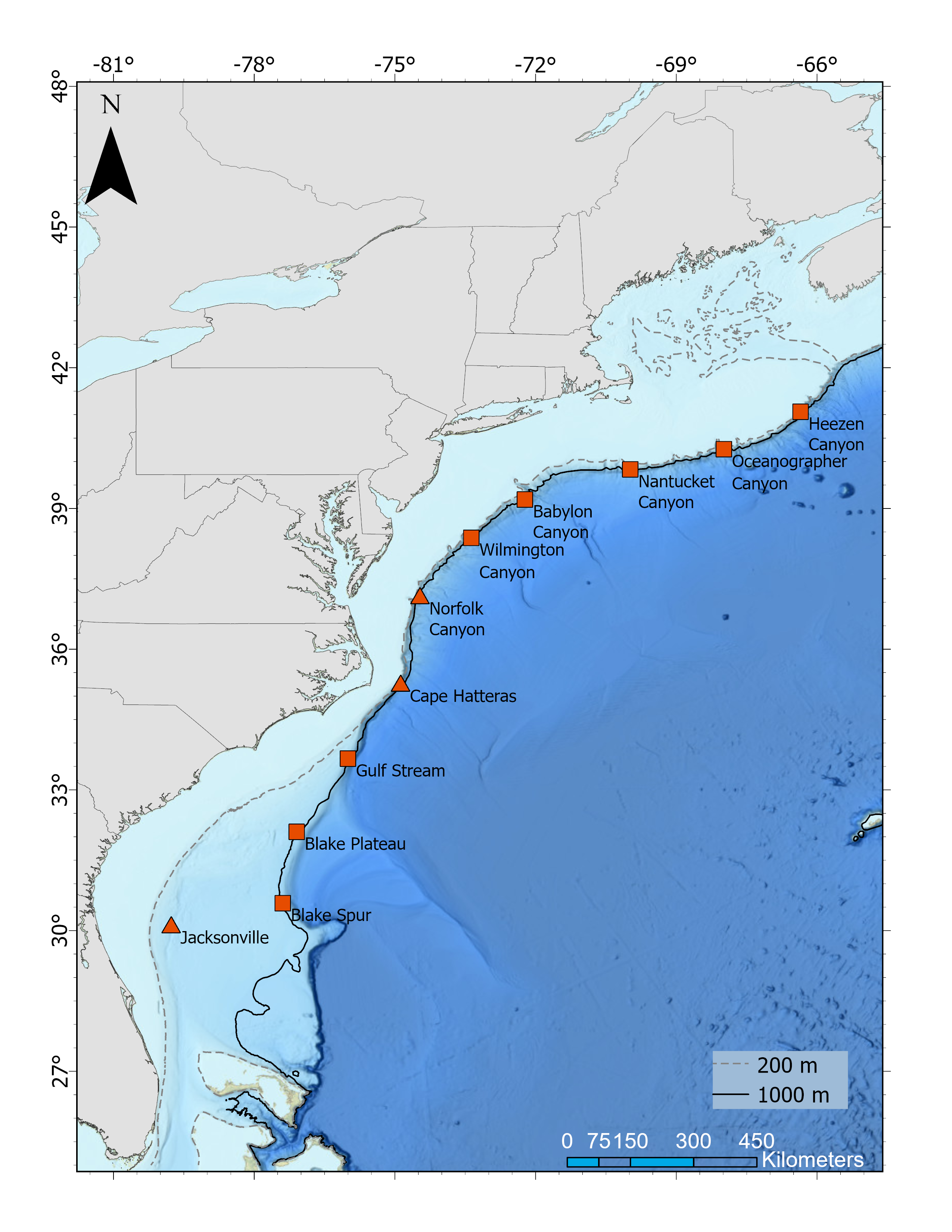
Acoustically sensitive species such as beaked whales inhabit the North Atlantic shelf break region, and all ESA-listed baleen whales, such as the North Atlantic right whale (Eubalaena glacialis), fin (Balaenoptera physalus), blue (Balaenoptera musculus), and sei whales (Balaenoptera borealis) are known to use this area to different extents. NOAA’s Northeast Fisheries Science Center and Scripps Institution of Oceanography (SIO) collaboratively deployed long-term high-frequency acoustic recording package (HARP) passive acoustic monitoring stations at eight sites along the western North Atlantic shelf break from 2015 to 2019 in coordination with the Bureau of Ocean Energy Management (BOEM). Likewise, the US Navy monitored the shelf break region at 3 to 4 sites from 2007 to 2022. Together these combined efforts bring the total to 11 recording sites spanning the U.S. eastern seaboard, from New England to Georgia.
Technical Approach
HARPS were deployed at 11 sites by the NEFSC and U.S. Navy along the Atlantic continental shelf break of the U.S. beginning as early as 2015. The sites deployed starting in 2015 include Heezen Canyon, Oceanographer Canyon, Nantucket Canyon (three northernmost sites), Norfolk Canyon, Cape Hatteras, and JAX (U.S. Navy deployments). These were expanded in 2016 to include Wilmington and Babylon Canyons north of Cape Hatteras as well as Gulf Stream, Blake Plateau, and Blake Spur south of Cape Hatteras. Each HARP was programmed to record continuously at a sampling rate of 200 kilohertz (kHz) with 16-bit quantization, providing an effective recording bandwidth from 0.01 to 100 kHz. Further details of HARP design are described in Wiggins and Hildebrand (2007).
Analysis of passive acoustic data utilizes manual analysis or specialized detectors, unsupervised learning and neural networks, and other methods. Programs used include MATLAB, Triton, and others.
Progress & Results
Analysis under this effort varies by year as the analytical components for key objectives are advanced. Work conducted in 2025 was aimed at these key objectives.
- Validate neural net classifications of beaked whales across HARP sites, with the goal to use the results for fine scale ecological questions.
- Assessing effects of anthropogenic noise on beaked whale vocal activity.
- Analyze minke whale presence at the Navy HARP sites.
Project Information
Timeline
2019-ongoing
Location
Northwest Atlantic
Passive acoustic monitoring
Principal Investigators
Drs. Sofie Van Parijs and Danielle Cholewiak
NOAA Northeast Fisheries Science Center
Sponsor(s) & Funding
Total - $1.4M, FY26 - $150k
Point of Contacts
Program Manager
Joel T. Bell
NAVFAC Atlantic
Environmental Conservation, Marine Resources Section
Deputy Program Manager
Jackie Bort
NAVFAC Atlantic
Environmental Conservation
Marine Resources Section
Data, Reports, & Publications
Technical Reports
Publications
Exploring the biodiversity of cetacean communities along the western North Atlantic Ocean shelf-break.
2025.
Royal Society
More details
Collapse details
Type:Ocean:Region:Species:Methods:
Monitoring the acoustic ecology of the shelf break of Georges Bank, Northwestern Atlantic Ocean: new approaches to visualizing complex acoustic data.
2021.
Marine Policy
More details
Collapse details
Type:Ocean:Region:Species:Methods:
This study aims to assess the co-occurrence of cetaceans and anthropogenic activities, presenting simple and accessible visualizations of the temporal and spectral overlap.
Exploring movement patterns and changing distributions of baleen whales in the western North Atlantic using a decade of passive acoustic data.
2020.
Global Change Policy
More details
Collapse details
Type:Ocean:Region:Species:Methods:
This study assesses the acoustic presence of humpback (Megaptera novaeangliae), sei (B. borealis), fin (B. physalus), and blue whales (B. musculus) over a decade, based on daily detections of their vocalizations.
Spatial and seasonal patterns in acoustic detections of sperm whales Physeter macrocephalus along the continental slope in the western North Atlantic Ocean.
2018.
Endangered Species Research
More details
Collapse details
Type:Ocean:Region:Species:Methods:
In the present study, we conducted multi-year passive acoustic monitoring to assess year-round sperm whale occurrence along the continental slope between Florida and New England, USA. Between 2011 and 2015, we collected 2037 d of recordings using bottom-mounted recorders deployed at 5 sites. We analyzed these recordings for sperm whale echolocation clicks, which were detected commonly between New England and North Carolina, but infrequently off the coast of Florida.
Using passive acoustic monitoring to document the distribution of beaked whale species in the western North Atlantic Ocean.
2017.
Canadian Journal of Fisheries and Aquatic Sciences
More details
Collapse details
Type:Ocean:Region:Species:Methods:
Little is known about the ecology of many beaked whale species, despite concerns raised by mass strandings linked to certain sources of anthropogenic noise. Here, we used passive acoustic monitoring to examine spatial and temporal patterns in beaked whale occurrence at six locations along the continental slope in the western North Atlantic Ocean.
Long-term passive acoustic recordings track the changing distribution of North Atlantic right whales (Eubalaena glacialis) from 2004 to 2014.
2017.
Scientific Reports
More details
Collapse details
Type:Ocean:Region:Species:Methods:
