
Ecological inferences about marine mammals from passive acoustic data.
Biological Reviews. 2023.
98:1633–1647
More details
Collapse details
Date Published:
Publication:Methods:
- May 4, 2023
Monitoring on the basis of sound recordings, or passive acoustic monitoring, can complement or serve as an alternative to real-time visual or aural monitoring of marine mammals and other animals by human observers. Passive acoustic data can support the estimation of common, individual-level ecological metrics, such as presence, detection-weighted occupancy, abundance and density, population viability and structure, and behaviour. Passive acoustic data also can support estimation of some community-level metrics, such as species richness and composition. The feasibility of estimation and certainty of estimates is highly context dependent, and understanding the factors that affect the reliability of measurements is useful for those considering whether to use passive acoustic data. Here, we review basic concepts and methods of passive acoustic sampling in marine systems that often are applicable to marine mammal research and conservation. Our ultimate aim is to facilitate collaboration among ecologists, bioacousticians, and data analysts.
Complete
Aerial Surveys of Marine Mammals Conducted in the Inland Puget Sound Waters of Washington, summer 2013 – winter 2016
Project Objectives
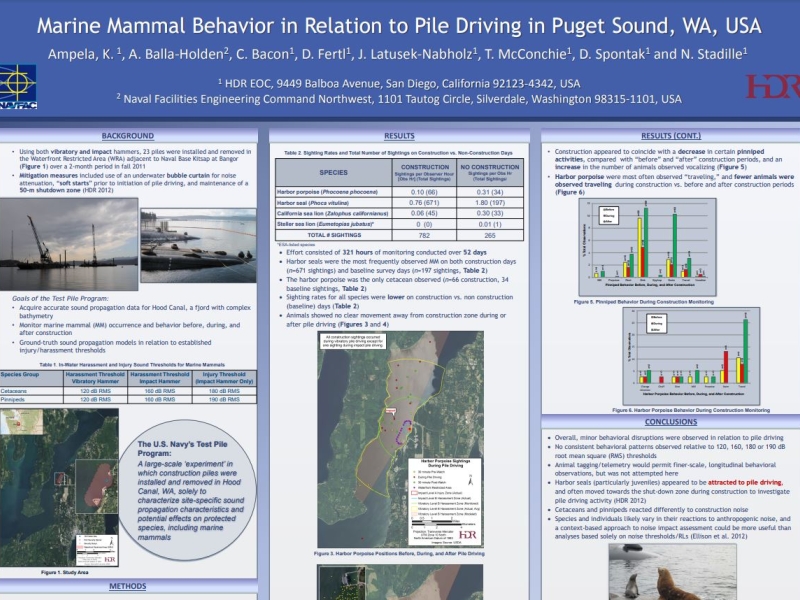
1) Conduct aerial surveys during four seasonal periods within the inland Puget Sound Survey Area to assess potential differences in seasonal distribution, numbers, and behavioral state patterns of marine mammals; 2) Collect data to estimate densities of marine mammals in the inland Puget Sound waters for species with sufficient sightings; 3) Estimate abundance for each marine mammal species seen an adequate number of times; 4) Document the distribution and habitat use of each species observed; 5) Document and describe behaviors seen without performing focal follows.
Complete
Vessel-based Marine Mammal Surveys in Puget Sound, Washington
Project Objectives
Conduct marine mammal in-water vessel-based line transect surveys in the Puget Sound basin to: 1) Record data on all marine mammal species seen with the study area, with a focus on the killer whale (Orcinus orca) and the harbor porpoise (Phocoena phocoena). 2) Identify the seasonal occurrence and abundance/density of cetaceans within the study area. 3) Identify the effects of environmental variables on the distribution and abundance of species in the study area.No related blog posts to display